FlowLineREPORT Score your tender risk

The Hazmat Freight Report · October 2026

11 years, 36,000 loads, and the year the hazmat premium doubled

Real rates, real mistakes and real saves from one freight agent's book, so you don't have to learn them the hard way.

ShippersOwner-operatorsFreight agents
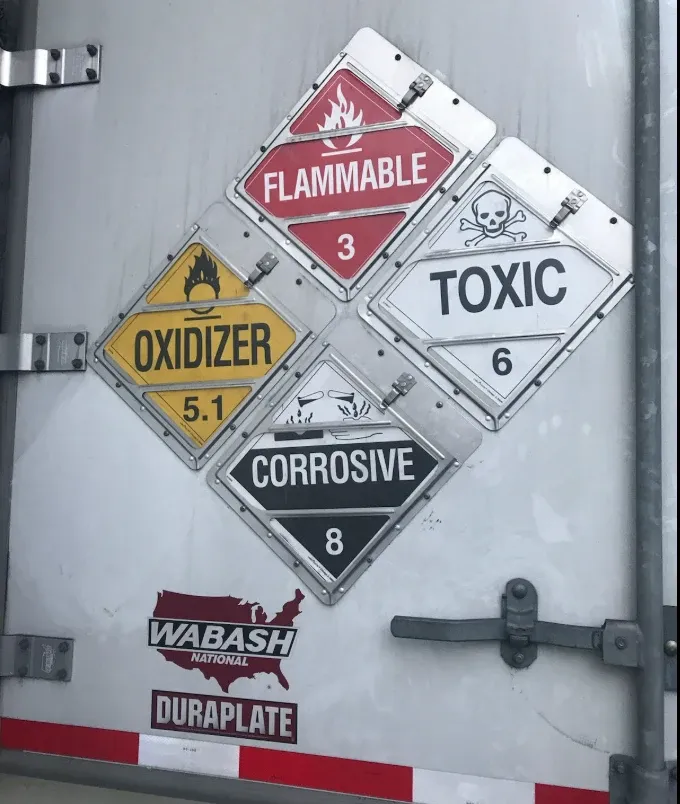
Four-way hazmat placard holder on the rear door of one of our trailers showing Class 3 Flammable, Class 5.1 Oxidizer, Class 6 Toxic and Class 8 Corrosive placards
A four-way placard holder on the rear door of one of our trailers: Class 3, 5.1, 6 and 8.
01

The hazmat premium doubled in 2023, and stayed there

From 2017 to 2022, hazmat paid 5 to 11 percent more per mile than regular freight in this book. In 2023 the gap jumped to 23 percent. When regular rates fell, hazmat rates didn't fall with them.

2017–20222023 onwardSmall sample, read with care
YearHazmat loadsHazmat $/miNon-hazmat loadsNon-hazmat $/miPremium
20161153.251,1992.6423%
20175862.748212.615%
20181,5872.881,0102.717%
20192,4942.771,3552.4911%
20202,4672.582,0352.417%
20212,0414.062,8613.6611%
20222,4884.923,6394.4710%
20232,1223.541,7732.8823%
20241,8373.431,9882.8222%
20255583.535512.9520%
2026 (to Oct 6)1094.161283.6016%

Averages of all-in charges per billed mile on moved loads. 2025 and 2026 volumes are lower partly because we lost our largest account in 2025; that story is in section 3.

It wasn't diesel

Fuel moves every truckload rate, so we checked our numbers against the U.S. Energy Information Administration's diesel price. In 2022 diesel peaked and both kinds of freight peaked with it. In 2023 diesel was still above $4, but regular freight fell back while hazmat held. Fuel hits both the same way, so the 2023 gap is something specific to hazmat.

YearU.S. diesel $/gal (EIA)Hazmat $/miNon-hazmat $/mi
20162.3043.252.64
20172.6502.742.61
20183.1782.882.71
20193.0562.772.49
20202.5512.582.41
20213.2874.063.66
20224.9894.924.47
20234.2143.542.88
20243.7603.432.82
20253.6603.532.95
2026 (Jan–Sep)5.0004.163.60

Diesel: EIA, "U.S. No 2 Diesel Retail Prices (Dollars per Gallon)", annual averages; 2026 is the average of the January to September monthly values, released October 20, 2026. Source.

Ian's take on why 2023 changed is coming: what he saw happen to hazmat carriers, insurance and capacity that year.
02

Rates you can price against

Median rate per billed mile on moved loads, January 2024 to October 2026. Medians, because a few odd loads pull averages around.

Freight typeLoadsMedian $/miAverage $/miAvg miles
Non-hazmat2,6682.642.88839
Class 3 flammable liquids1,8053.273.58748
Class 8 corrosives4963.133.50682
Mixed-class hazmat1902.372.63882

Mixed-class loads come in under non-hazmat here, which runs against expectations. It's 190 loads, so read it with care until we can explain it.

Distance is where hazmat really costs more

Billed milesHazmat loadsHazmat median $/miNon-hazmat loadsNon-hazmat median $/mi
Under 2501125.822163.63
250 to 4997354.765283.43
500 to 9999983.029172.69
1,000 and up6592.639592.31
For shippers: a short hazmat haul costing 60 percent more per mile isn't a broker padding the quote. Placards, endorsed drivers, loading time and insurance cost the same whether the truck goes 200 miles or 1,200, and on a short run they're spread over fewer miles.
03

How shippers actually grade carriers

I went back through years of shipper and broker emails and pulled out what they actually held us to. Not what's in the routing guide; what they emailed about when it went wrong.

  1. Answer every EDI tender inside the window. One shipper gave carriers one hour to accept or decline, then moved the load to the next carrier.
  2. Keep your commitments. Zero missed pickups, and fewer than 5 percent of booked loads given back.
  3. Track every load. One broker scorecard wanted 95 percent autotrack; we were at 83.7.
  4. Tell them first. Report the problem before the customer asks, and reply within 15 minutes.
  5. Make the paperwork match. Rate con, BOL, POD and invoice, with no duplicate billing.
  6. Quote fast, quote real. A linehaul rate with pickup and delivery ETAs the same day, at a market price.

The tender that cost us the account

February 2025

Our largest shipper's tenders passed through three systems before they reached us: an EDI gateway, a McLeod TMS and another TMS. We only knew a tender existed from an email alert, and those alerts had stopped coming. One load came in at 1:14 PM and we accepted at 2:33 PM, 79 minutes later, past their one-hour window. The tenders didn't even carry a respond-by time. Another shipper's tenders did, back in 2021, with the deadline to the second.

By late May the account was gone. They'd heard "we'll fix EDI" too many times for it to mean anything.

Same tools, better service

May 2025

When I saw where the freight went, I wrote: they have the exact tools we have, so they must be providing better service. The tools weren't the difference. How fast the tender reached a person was.

04

How the technology changed

Every few years the tools changed what customers expected. The ones who kept up kept the freight.

2019A customer disputed a delivery time. Instead of the driver's word, I answered from the truck's ELD: in 07:20, out 9:27. The ELD went from a compliance chore to evidence.
2022I built my own BI reporting. When the numbers showed a $4M increase, my answer was Profits what's matters. Revenue is vanity if the margin isn't there.
2022–23FreightWaves market data became the team's morning read. I forwarded tender-rejection alerts marked VERY IMPORTANT TEAM to get the desk reading the market before it moved.
2023We tried a paid freight marketplace. It brought 5 to 10 bids, mostly overseas. We dropped it. Two months later I asked our carrier for a technology portal: we need technology… be different then the other's. They were piloting their own system. That's when I started building mine.
2024–26Tracking stopped being optional. Brokers began holding back full load details until tracking was on, and billing rejected rate cons that didn't include it.
2026AI agents that handle the repetitive work, tested the only way that matters: I need proof.
Coming from Ian: the fax-and-phone years before 2019, and what changed for drivers the day ELDs became mandatory.
05

The COVID years

Drivers at the dock, waiting on a form

May 2020

A broker needed a carrier assessment form before our drivers could load. The office that had to fill it out was working remotely, and it took over an hour while trucks sat. Lesson: every document a customer might ask for should be one click away, not one phone call.

Paying drivers to hold over the holidays

December 2021

The receiver was booked until the 26th. We asked the shipper to approve $1,000 a load for drivers to hold, and they said yes. Lesson: ask for the money up front, in writing, before the driver eats the delay.

A week of missed pickups

December 2021

A shipper wrote one word in the subject line: HELP. The team sent an ETA for every open order the same afternoon and recovered the week. Lesson: when it's going wrong, overwhelming visibility buys back trust faster than apologies.

Coming from Ian: the drop-trailer decisions, staffing calls and carrier-selection mistakes from 2020 to 2022.
06

Saves and mistakes

The wrong product, two days before Christmas

December 2024

A hazmat load was loaded with another load's product. Two drivers were trying to get home for the holidays. We swapped the loads between them, asked the shipper to cover the cost, and they said yes. It delivered on the 26th. Lesson: own the mistake, price the fix, and ask.

A down truck and a load that sat two weeks

December 2022

Our assigned truck broke down. The load sat on the supplier's report every day for almost two weeks before we asked for it to be reposted. Lesson: when you can't cover it, say so on day one. A lost load hurts less than a lost customer.

"Nobody told me the appointment was pending"

December 2022

A carrier sat two days at a receiver because the delivery appointment was still pending and nobody had said so. That became a detention fight. Lesson: an appointment that isn't confirmed is the carrier's problem to know about, and yours to tell them.

Carriers stay in their networks

July 2024

We lost loads because, as I put it then, everyone is sticking within their networks. Lesson for agents: build your own carrier relationships before you need them.

07

Voices from the road

"It's the best job I ever had. And you're the reason for that. Still feel free to give my number to new prospects, I will tell them the truth."

Calvin, LIVE Global Logistics Driver of the Year, in a text to me, September 2018

Public Google reviews

Great team works hard and does a good job keeping you moving on good haz-mat loads and communicates well with drivers.

Luke · Google review · December 2018

Professional Hazardous Materials Transport. Experienced Logistics professionals.

Rochell D · Google review · January 2018

Absolutely good service. Great company I have worked with them a lot and always a pleasure.

Adam Stafford, carrier · Google review · June 2025
More drivers are adding their own answers on ELDs, COVID, what makes a broker worth hauling for, and what shippers should understand about hazmat.
08

What to do with this

Shippers

  • Put a respond-by time on every EDI tender. Without it, carriers can't tell your deadline.
  • Expect hazmat to cost about 20 percent more per mile since 2023, and much more on short runs.
  • Ask carriers how a tender reaches a person, not just whether they do EDI.

Owner-operators

  • Short hazmat runs pay the most per mile in this data.
  • Your ELD is your evidence. Use it to settle delivery and detention disputes.
  • Get holding pay approved in writing before you hold.

Freight agents

  • Know every system between the shipper and you. If one alert fails, so does the account.
  • Track give-backs and autotrack the way your brokers do, before they score you.
  • Own your carrier relationships. Networks close up in tight markets.

If a missed tender has ever cost you freight, score your tender risk in six questions.

09

How we counted

Source: one freight agent's moved truckload freight, June 2015 to October 6, 2026 (36,712 orders before filtering). Quotes, cancellations, offered and available loads are excluded. Loads under 50 billed miles or with no charge are excluded from rate figures.

Rate per mile is total charges divided by billed miles, so it includes fuel surcharge and accessorials. Hazmat is identified from the DOT hazard category in each load's commodity description: flammable and combustible liquids, corrosives, gases, and mixed-class loads.

Diesel prices are from the U.S. Energy Information Administration and are included as an outside reference, not used to adjust any rate.

These are averages and medians, not adjusted for lane, region, equipment or season. Equipment is mostly 53-foot van. Customer names are left out. Stories come from dated emails, and identifying details have been removed.

Look up your own number

Every figure in this report, as a calculator: pick a hazard class and a distance and see the median all-in rate, the spread and the load count.

Look up a rate by class and miles →